

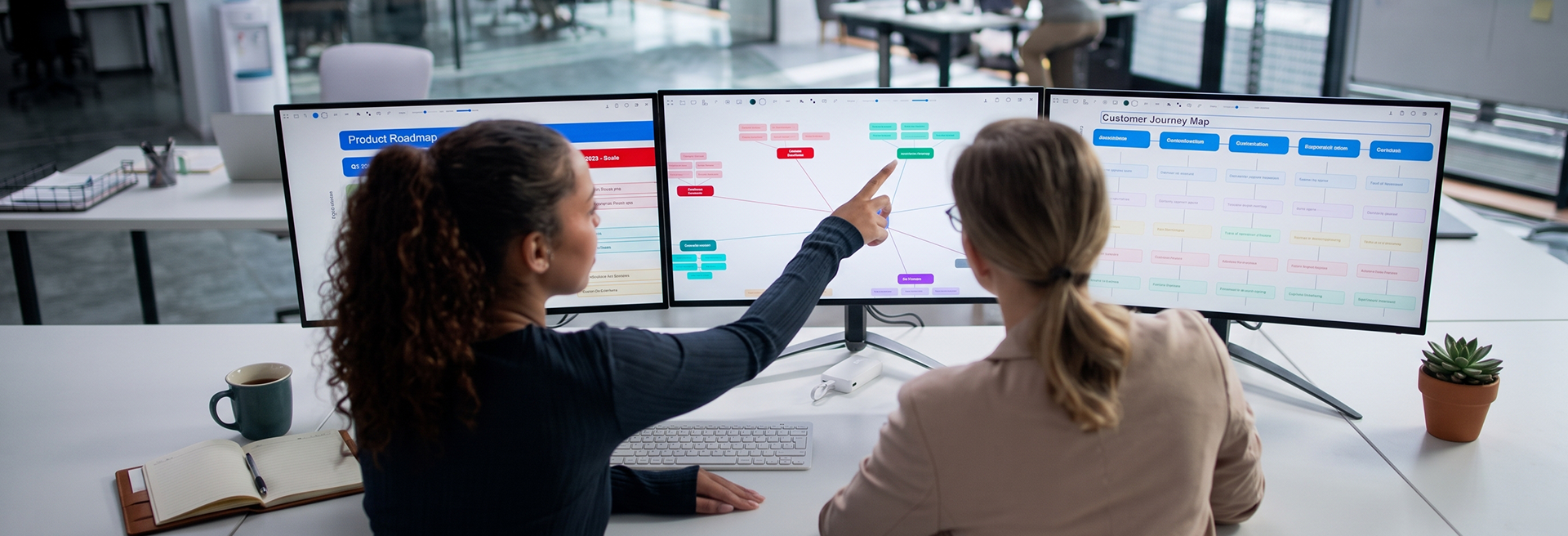
Being a product owner of our in-house online community platform is one of my favorite aspects of my role. Not because I get to work with technology or use creative thinking to recommend the best layout for a page (which are also great), but because it gives me real influence on the evolution of the main tool we as researchers on the Online Communities team use day to day.
Approaching product ownership through the lens of a researcher gives me a unique results-forward perspective. Just as I design a research study by thinking about the end goal and business decisions in mind and working backwards, I approach platform decisions by focusing on the ultimate value we want to deliver first then finding the path to get there. This is not always as straightforward as it may seem; just like with our clients, the end goal is not always evident at face value and it may take some digging to uncover what the user’s true needs are. Then, the most challenging part is prioritizing those needs: deciding what gets built next, what gets pushed back and why. That challenge becomes clearer when you look at who is actually using the platform.
I have found that being a product owner for an online community specifically comes with nuances. This is mostly due to the fact that unlike many other platforms, we have several separate "types" of users, all having vastly different priorities, including respondents, moderators, upper management, accounting and clients. From a researcher perspective, I hesitate to combine these user groups (similar to how we view different consumer segments) but rather treat them as distinct audiences with different needs. By viewing them as a uniform audience or only focusing on one, I have ended up underserving another group.
Early on, one of the biggest questions I asked myself in this role was, "What is the next priority?" This always proved to be too loaded of a question, often leading me down rabbit holes and right back to where I started. Over time, I’ve learned not to ask this, but rather: "What will have the biggest impact right now, and to whom?"
Being a daily user of the platform as a product owner is a double-edged sword. I know the ins and outs deeply, but I am also naturally biased toward my own daily workflow when prioritizing updates. As researchers, we are constantly trained to check our bias and avoid leading respondents, yet when wearing the product owner hat, it is deceptively easy to forget those frameworks, get stuck in a “moderator mindset,” and push through updates that only benefit my projects or immediate team.
Product ownership requires the same empathy and objectivity we bring to research for every type of user. I am regularly forced to step outside of my role to map out the biggest pain points other users are facing, weighing the impact of each. This requires me to put myself in their shoes and ask:
The user experience is only half of the equation, another big piece of the puzzle is our dev team. We have a small (but mighty!) group of developers. With a small team, their time is precious, and using it wisely is crucial to staying productive and making progress. There are two main factors I consider when thinking about each update:
This role is full of tough decisions and prioritization is more of an art than a science. In full transparency, I am rarely 100% sure if I’m making the perfect call, and I might never be. What matters most is applying a true researcher mindset: staying thoughtful, listening to data over assumptions, and continually adapting to change.
This connection runs both ways. While my research background guides how I manage the platform, being a Product Owner has made me a far more strategic researcher. Sitting in the driver’s seat of this role and navigating trade-offs, resource limits, and competing stakeholder demands, gives me empathy for what our clients face when making high-stakes decisions. Exercising this strategic muscle daily allows me to write research reports that deliver far more actionable, business-focused recommendations.


